I really like the accent in this video, but I think I need to show more emotion in my face and body language.
Friday, 11 October 2013
Writing in Role - After Grampa's Death
Grampa, Grampa's gone. We buried him in the groun' today and I, I jus' felt like cryin', and the cryin' feelin' wouldn't go away, and I just felt like cryin' and cryin' but I couldn't cry because, no matter if Tommy's here or in McAllister, I'm still one of the men in this god damn fambly, I gotta be strong for the fambly; I mean Winfield looks up to me and well, I've been lookin' out for Rosasharn since Tommy went away, makin' sure Connie doesn't step outta line. I gotta be strong for the Fambly. Grampa was always there to make decisions and look after us but now he's gone, I guess we all just gotta step up alittle bit and make sure the family stick together. He looked after Ma when she was just a kid, and then looked after me too, he looked after all of us. Now he's gone.

Wednesday, 9 October 2013
09/10/13
Since my last blog entry, I've spoken to Miss and have talked about how Al wouldn't like Tom's return because Al enjoys being the man of the house so this explains why he might be blunt to Tom in the first appearance, pg 20.
This lesson we've worked on movement which I felt really helped because it just made me think alittle bit more about character and I think I did well to present how Al is quite mature. I performed with Connor (Noah), which was good because even though Noah's the eldest brother, it showed that Al was the man of the House.
We also rehearsed Grampa's funeral for the first time, it reminded me of how I felt at my own Nan's funeral and so I could really relate with Al and perform as him better. I think the scene would have been better with Amanda was in lesson for her lines.
http://www.youtube.com/watch?v=4IJnLaBcfuQ
This lesson we've worked on movement which I felt really helped because it just made me think alittle bit more about character and I think I did well to present how Al is quite mature. I performed with Connor (Noah), which was good because even though Noah's the eldest brother, it showed that Al was the man of the House.
We also rehearsed Grampa's funeral for the first time, it reminded me of how I felt at my own Nan's funeral and so I could really relate with Al and perform as him better. I think the scene would have been better with Amanda was in lesson for her lines.
http://www.youtube.com/watch?v=4IJnLaBcfuQ
Writing in Role
We shouldn’t of had to leave our lan’, it’s been horrid; the dust storm and crops dying. but I guess the Fambly means a lot to me and I couldn’t split it up just yet, although, I’m getting old an’ I can’t stay with Ma an’ Pa forever; California’s gunna have a bunch of opportunities for me, some I dunno if I can afford to miss.
Havin’ Tom back, it’s a funny feelin’. He’s my brother and he’s don’ some great things but, well I dunno, he can’t just walk back into the fambly and expect it to be in the same state it was 4 years ago. I’m not 12 anymore. An’ that Rev Casey, it’s one more spot on the truck, I’m not sure if she’ll be able to handle it al’ the way. Not to mention Grama or Grampa, Grampa seemed illby the time we were leavin’. I suppose we’ll just have to wait and see.
Havin’ Tom back, it’s a funny feelin’. He’s my brother and he’s don’ some great things but, well I dunno, he can’t just walk back into the fambly and expect it to be in the same state it was 4 years ago. I’m not 12 anymore. An’ that Rev Casey, it’s one more spot on the truck, I’m not sure if she’ll be able to handle it al’ the way. Not to mention Grama or Grampa, Grampa seemed illby the time we were leavin’. I suppose we’ll just have to wait and see.
Thursday, 3 October 2013
02/10/13
Today I performed a scene with Amanda, who plays Ma, which was a one on one chat between the characters. I found that even though I was still playing Al, he was completely different to in the scene that we performed yesterday, the stage directions made him seem older. Think this is because Al has had to be more protective and mature for his family because of the conditions and that his eldest brother has a disability, and Tom has been in prison, so in the scene with just Al and Ma, Al might feel like he has to take on some more of that maturity but when Tom's around, the maturity can be dropped and Al can be more like a 16 year old if he wants.
01/10/13 & Al
Today with found out our roles for the Group performance of John Steinbeck's 'Grapes of Wrath' and I got Al, one of the younger Joad brothers. For the rest of the lesson we ran from page 7 through to page 23 working on characters.
Al Joad

From reading from the script so far I've learnt that Al is 16 and quite smart with the truck. When he first enters on page 20, he walks with a "swagger", but this would be more western, like in Mightnight cowboy:
I also think Al had to be more mature than a modern 16 year old because he had to care for his family due to the horrible conditions of the Great depression and the dust bowl, but also because he feels he has to take on the role of an older brother in the family; the oldest son, Noah, has mental problems and Tom, the second born, has been in prison since Al was 12. However because Tom returns at the start of the play, Al is shifted down in the family ranks.
Research
Al Joad is described to "billygoat" and "tomcat" his way around the country, showing he isn't too bad with women. He drove a truck for a company the year before, and so he becomes the family mechanic, able to drive cars and fix them, too. He looks up to his older brother, Tom: "Al knew that even he had inspired some admiration among boys of his own age because his brother had killed a man" (8.135). However, living in his big brother's shadow can be a lot of pressure.
Al likes girls a lot, but he has no intention of getting married anytime soon (he is only sixteen). He promises to marry one girl in Weedpatch, and then eventually gets engaged to another girl who lives in the same abandoned boxcar as he does. As the winter rains flood the land, Al decides to split apart from his family, remaining with his fiancée and her family.
Adapted from http://www.shmoop.com/grapes-of-wrath/al-joad.html
Al Joad
From reading from the script so far I've learnt that Al is 16 and quite smart with the truck. When he first enters on page 20, he walks with a "swagger", but this would be more western, like in Mightnight cowboy:
I also think Al had to be more mature than a modern 16 year old because he had to care for his family due to the horrible conditions of the Great depression and the dust bowl, but also because he feels he has to take on the role of an older brother in the family; the oldest son, Noah, has mental problems and Tom, the second born, has been in prison since Al was 12. However because Tom returns at the start of the play, Al is shifted down in the family ranks.
Research
Al Joad is described to "billygoat" and "tomcat" his way around the country, showing he isn't too bad with women. He drove a truck for a company the year before, and so he becomes the family mechanic, able to drive cars and fix them, too. He looks up to his older brother, Tom: "Al knew that even he had inspired some admiration among boys of his own age because his brother had killed a man" (8.135). However, living in his big brother's shadow can be a lot of pressure.
Al likes girls a lot, but he has no intention of getting married anytime soon (he is only sixteen). He promises to marry one girl in Weedpatch, and then eventually gets engaged to another girl who lives in the same abandoned boxcar as he does. As the winter rains flood the land, Al decides to split apart from his family, remaining with his fiancée and her family.
Adapted from http://www.shmoop.com/grapes-of-wrath/al-joad.html
The Dustbowl
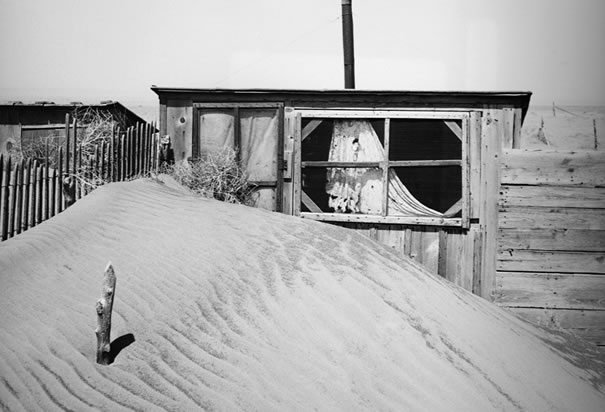
The play is set just after the event known as the "Dust Bowl" in America. For almost 10 years, the Southern states of the US were covered in major dust storms which wiped out the crops and destroyed homes. History says "The simplest acts of life - breathing, eating a meal, taking a walk - were no longer simple. Children wore dust masks to and from schools, women hung wet sheets over the windows in a futile attempt to stop the dirt, farmers watched helplessly as their crops blew away." Steinbeck wrote his novel The Grapes of Wrath in 1939 towards the end of the natural disaster.
From History GCSE I know that on Black Thursday 1929 the Wall street Stock Market Crashed, so the Joan Family would have been very lucky to keep their homes anyway, putting the country in depression, then to further worsen conditions, a dust bowl swept across the southern agricultural states of America meaning that all crops were ruined and covered in sand, Houses and cars were ruined by the sand and land was dried up.



First hand accounts
“If you would like to have your heart broken, just come out here”
Ernie Pyle, Kansas
June 1936
“In the dust-covered desolation of our No Man’s Land here, wearing our shade hats, with handkerchiefs tied over our faces and Vaseline in our nostrils, we have been trying to rescue our home from the wind-blown dust which penetrates wherever air can go. It is almost a hopeless task, for there is rarely a day when at some time the dust clouds do not roll over. 'Visibility’ approaches zero and everything is covered again with a silt-like deposit which may vary in depth from a film to actual ripples on the kitchen floor.”
Reader's Digest magazine, Oklahoma
June 1935
From History GCSE I know that on Black Thursday 1929 the Wall street Stock Market Crashed, so the Joan Family would have been very lucky to keep their homes anyway, putting the country in depression, then to further worsen conditions, a dust bowl swept across the southern agricultural states of America meaning that all crops were ruined and covered in sand, Houses and cars were ruined by the sand and land was dried up.
First hand accounts
“If you would like to have your heart broken, just come out here”
Ernie Pyle, Kansas
June 1936
“In the dust-covered desolation of our No Man’s Land here, wearing our shade hats, with handkerchiefs tied over our faces and Vaseline in our nostrils, we have been trying to rescue our home from the wind-blown dust which penetrates wherever air can go. It is almost a hopeless task, for there is rarely a day when at some time the dust clouds do not roll over. 'Visibility’ approaches zero and everything is covered again with a silt-like deposit which may vary in depth from a film to actual ripples on the kitchen floor.”
Reader's Digest magazine, Oklahoma
June 1935
Subscribe to:
Posts (Atom)